
Consumer Trends
What GLP-1 users are buying, two years in
Food spending remains high, treats bounce back, and alcohol keeps falling.
 By Dan Frommer on Friday, October 30, 2026 at 10:00 am
Hello hello! It’s Dan Frommer, back with The New Consumer. How are you?
Instacart has agreed to sell itself to DoorDash for $17 billion, the companies announced this week. I’ll write more about this soon, but from The Information’s reporting, it sounds like Instacart saw growth getting harder, and decided it’d be better off as part of DoorDash or Uber, as they all go up against Amazon and Walmart. (And it wanted to get a deal done while Trump, whose administration it sees as relatively deal-friendly, is still in office.)
Today: New data on how GLP-1 users spend on groceries, dining, and clothing two years after starting treatment. The good news: Dessert isn’t dead.
I’m also kicking off a new series called Travel Agents, where I explore the AI-powered future of travel booking and research. These first few are sponsored by Navan Edge, the AI agent for business travel, which I’ll be using and reviewing over the coming weeks.
Presented by Navan Edge
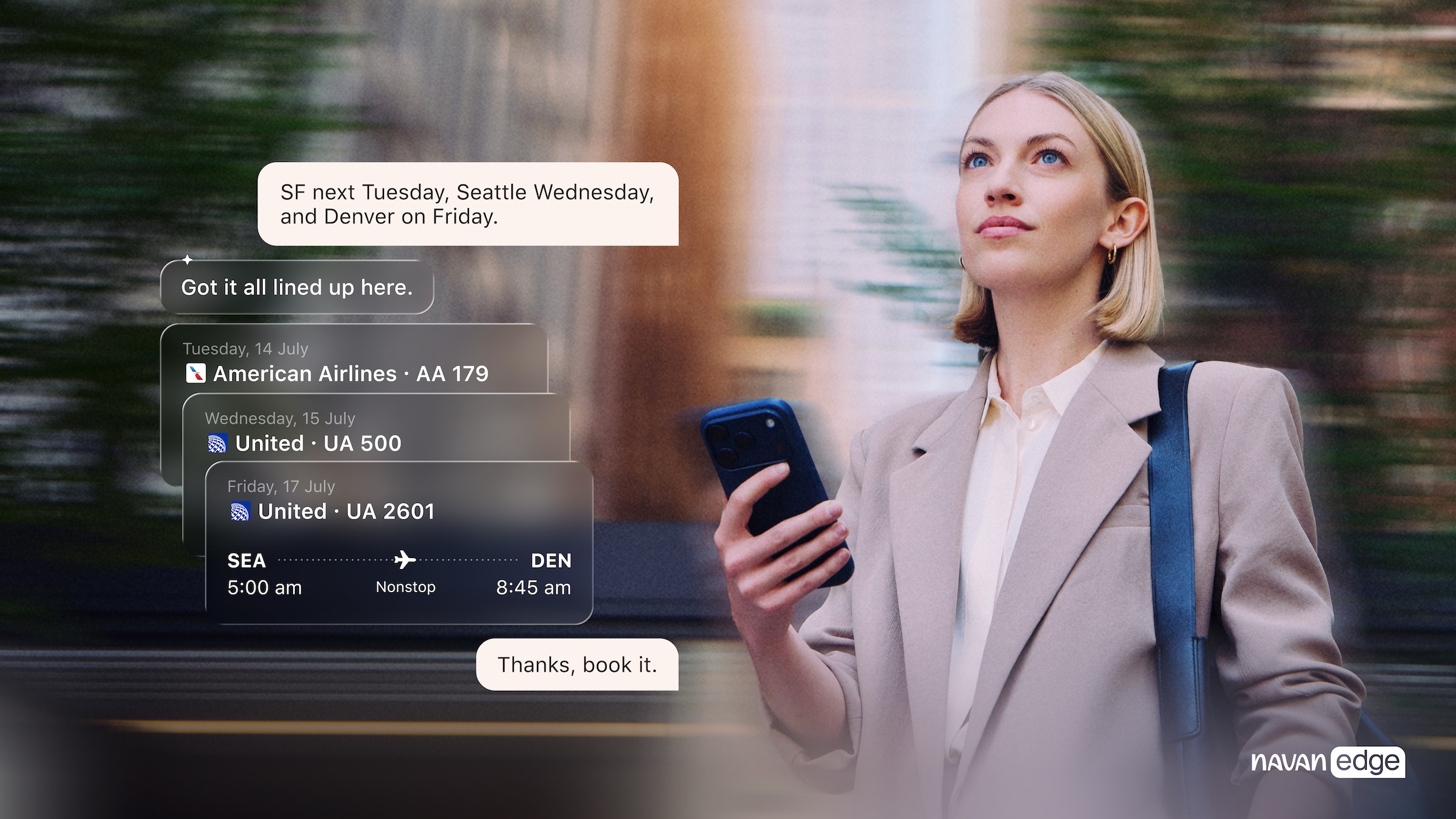
Introducing Travel Agents, a special series about travel planning and booking in the age of AI. Sponsored by Navan Edge.
The way people book travel online has been mostly the same for decades: Pecking and picking through abbreviations and menus. But that’s starting to change.
For the past several weeks, I’ve been testing a new service called Navan Edge, an AI-powered travel app from Navan, the business travel and expense platform that drove more than $9 billion in bookings during its last fiscal year.
Navan Edge is designed for “prosumer” travelers: frequent business travelers who don’t have access to a corporate travel booking tool — like myself.
In this series, I’ll post my experiences and thoughts about using Navan Edge and the bigger idea: How AI-powered digital assistants, like Navan Edge and Meta’s new Muse, are (and aren’t) changing travel research, booking, and the on-trip experience — things like managing your itinerary if there’s a cancellation or other disruption.
Key questions I’m thinking about: How much of the market might these tools capture? Is this actually a better interface? Can it really be more personal in a way that helps? How much responsibility will people outsource to agents? Is it important that the tool has special training, data pipes, and commercial relationships for travel?
Navan Edge is a chat-based interface; every trip is a new chat. You start with a prompt — as simple or as detailed as you want — and can research flights, hotels, restaurants, and more.
I needed to go to Sun Valley for a short business trip last month, so I started with flights. Instead of poking pop-ups, I just typed. Something like: The nonstop flight there, and then on the way back, tell me what the nonstop returns are, and if there’s a later one-stop return that would get me in before 1am. The nonstop ended up making more sense, even though it was on an airline I don’t usually fly. Entering “Book now” purchased my ticket — without having to download or log into a different app or website. (Qualifying flight bookings earn miles like any other ticket.)
I’d never been to Sun Valley before, so my next question was: Where to stay? Navan Edge recommended a handful of hotel options; I narrowed by neighborhood (downtown Ketchum) and budget (under $300) and picked one from the Navan Lodging Collection, a group of hotels with pre-negotiated rates and amenities for Navan Edge users. (Another in-chat booking I didn’t need to do on an external site.) At check-in, I was delighted to find out that I’d been upgraded to a comically large room. Navan tells me this was part of its “Surprise & Delight” program, which treats eligible users to extras — such as gift boxes, restaurant credits, and upgrades — on some trips.
Because Navan has relationships with several top hotel chains, many bookings earn loyalty points. And to encourage hotel booking through Navan Edge, they currently offer travelers with Gold status (or higher) at major airlines or hotels a bonus: 10% back on eligible hotels in the form of Amazon gift cards.
This was a pretty simple trip with very few choices, and everything went smoothly. In my next piece in this series, I’m looking forward to putting Navan Edge (and some other agents) to the test on something more personalized and nuanced, in a city with vastly more choices. I’m also curious how general-purpose tools like ChatGPT do as they add more travel booking connectors — since they already know a lot about my broader life and preferences. But so far, in my experience, Navan Edge’s travel-specific plumbing looks like an advantage.
One of the biggest and most important questions in the consumer world remains: As GLP-1 weight-loss drugs — Ozempic, Mounjaro, Zepbound, etc. — go mainstream, how will they change the way people live and spend?
So far, the answer has mostly been: People don’t stop spending money on food, even as they consume less. But they spend it differently.
And it’s not a niche question anymore. In a September survey by Circana, the market research firm, 30% of US households — roughly 40 million — report having at least one current GLP-1 user. Counting households with anyone who has ever used one, it’s 37%, up from 27% a year ago and 17% two years ago.
Now Circana has released a new study that tracks GLP-1 users’ household spending for two years after they begin treatment, based on receipt transaction data. It’s a follow-up to its one-year report, which I covered last year. (Fwiw: This covers households where someone started a GLP-1 between 2024 and 2026 and was still taking it as of this summer.)
Two years in, the clearest pattern is that GLP-1 users want it both ways — more protein and more candy.
The big picture, still: Households with GLP-1 users remain above-average food spenders.
In the year before starting a GLP-1, they spend 8% more on groceries (“CPG food and beverage”) and 21% more at restaurants (“foodservice”) than an average non-GLP-1 household.
CHART OF THE DAY
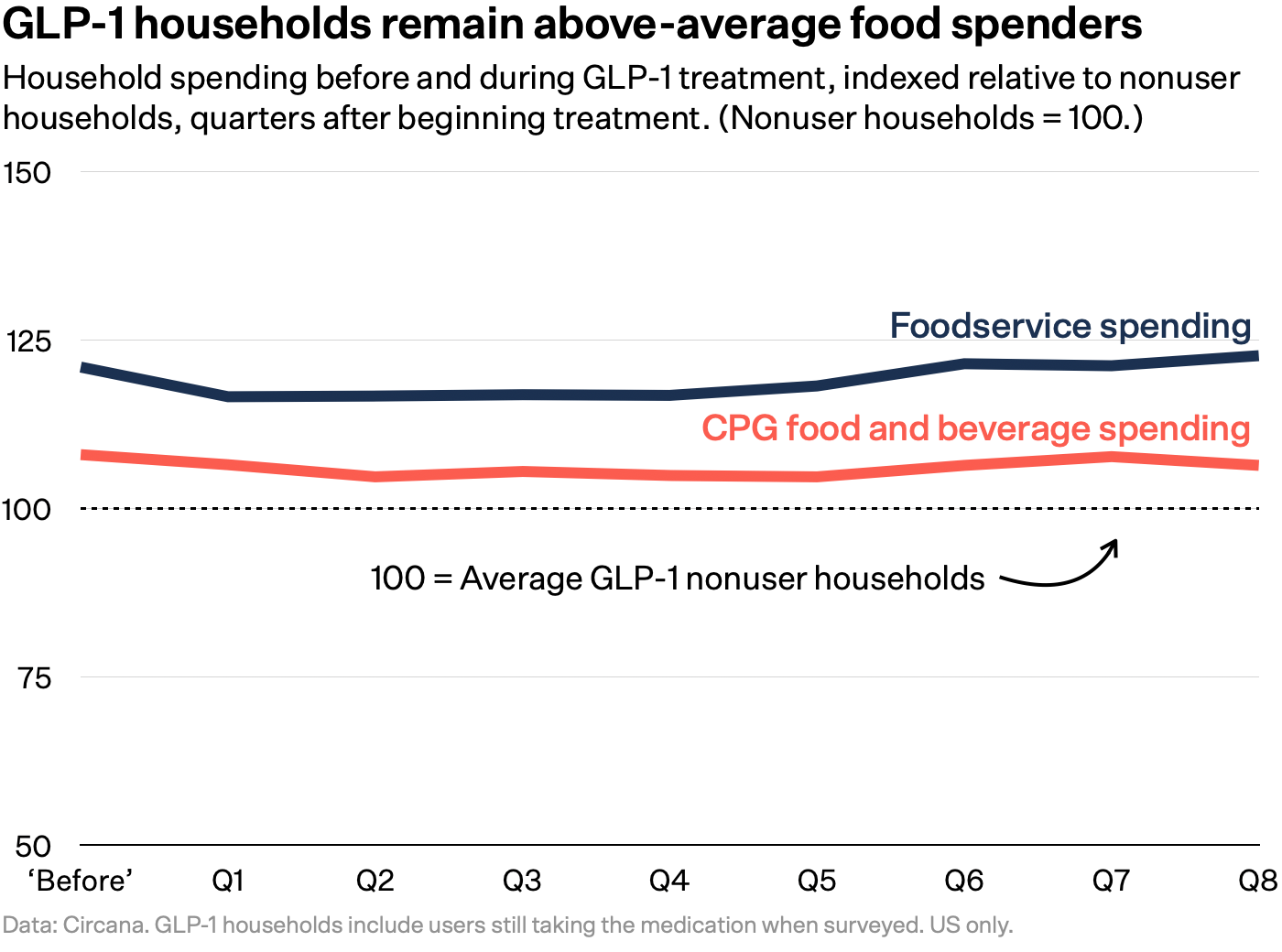
In the first year on a GLP-1, that lead shrinks a little. In the second year, spending rebounds. By the end of year two, grocery spending is nearly back to its pre-GLP-1 level — and restaurant spending is slightly higher than where it started.
Food spending doesn’t collapse just because someone in the household is on a highly effective weight-loss medication that’s designed to make them eat less.
Dessert isn’t dead, either!
The rest of this post is for paid members of The New Consumer.
Join for or .
Already a member? Sign in here.

Hi, I’m Dan Frommer and this is The New Consumer, where consumer operators, founders, and investors get the real read on what’s happening — original reporting, proprietary data, and sharp analysis you can take into your next meeting.
You’ll get my twice-weekly newsletter, read by leaders at Sweetgreen, David Protein, Forerunner, and L Catterton. Plus Consumer Trends, our research series cited by the Wall Street Journal, Axios, and WWD.
Not ready to join? Start with a free account.