
In Conversation
Molly’s World
Molly Baz, food media star and world builder, on creating her new sauce brand Ayoh, playing the YouTube game, and what she wants to do next.
 By Dan Frommer on Thursday, November 21, 2024 at 4:00 pm
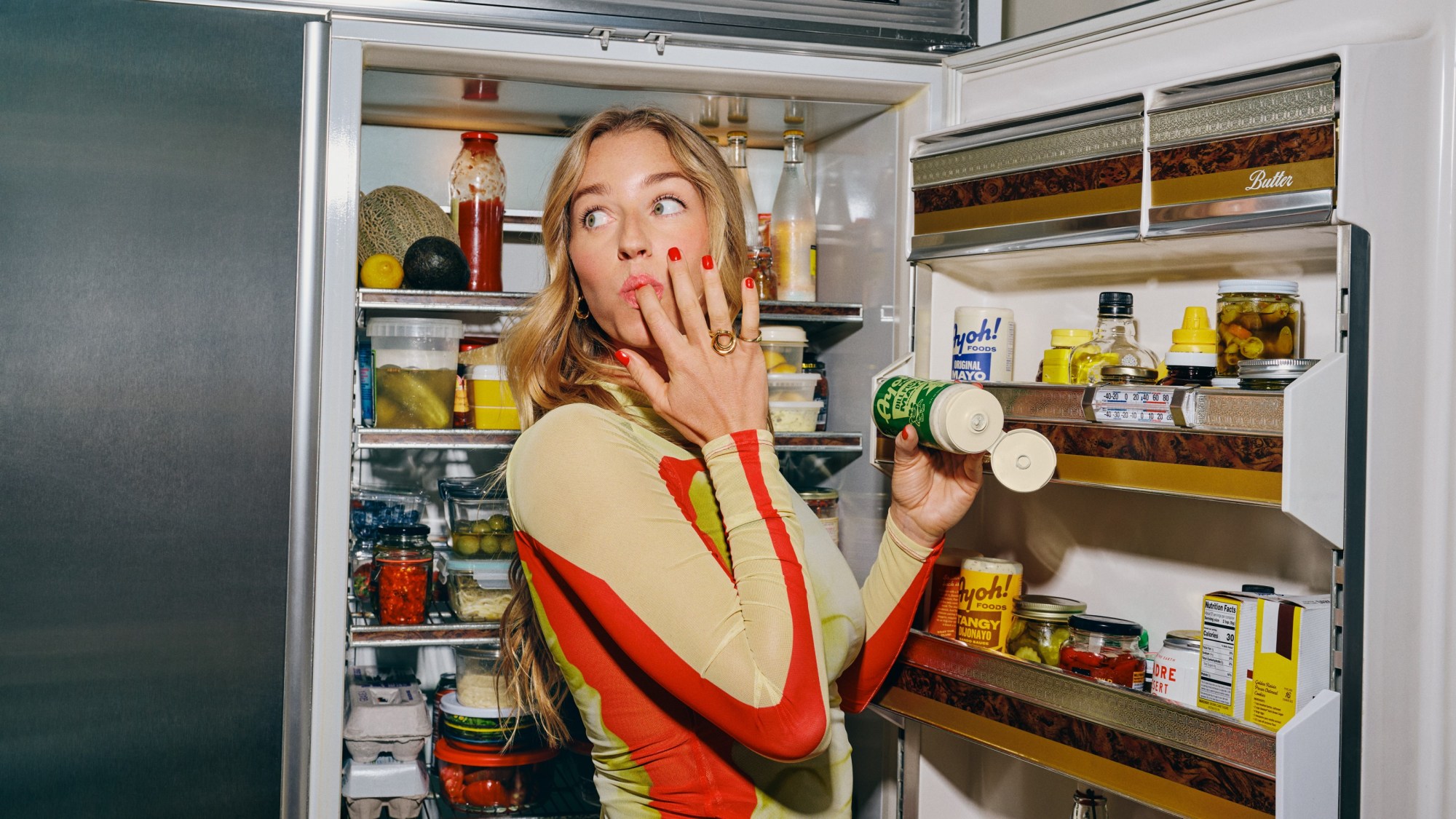
While many food media personalities have built large followings and personal brands, Molly Baz has been building a portfolio.
In addition to her media channels — almost 800,000 Instagram followers, 140,000 YouTube subscribers, more than 300,000 copies of her cookbooks sold, and a membership-based newsletter and website that she says is now around half of her business — Baz has launched a natural wine brand, Drink This Wine, with The Marigny, one of my favorite producers; designed a kitchen and dining product collection with Crate & Barrel; and more collaborations and campaigns — you may have seen her breastfeeding in Times Square for the formula brand Bobbie — just over the past few years.
Her latest is even Molly-er: Ayoh Foods, a sauce brand that she launched this week with a collection of four mayonnaise-based “sando sauces.”
Like Baz and her recipes, the Ayoh world is loud, bright, a little over the top, and adds new words to The New Consumer lexicon, including Hot Giardinayo, a spicy mayo with chunks of Chicago-style giardinera, and Tangy Dijonayo, a French-leaning mustard-mayo sauce with whole pickled mustard seeds and chunks of baby cornichon pickles.
The innovation here is the texture — it’s like going from creamy peanut butter to chunky — and Ayoh’s third flavor, a spicy Dill Pickle mayo, with crunchy pickles and lots of dill, pushes the limits on what you’d imagine possible from a shelf-stable condiment. I’ve tried them all, and am impressed — I’ll actually be using these.
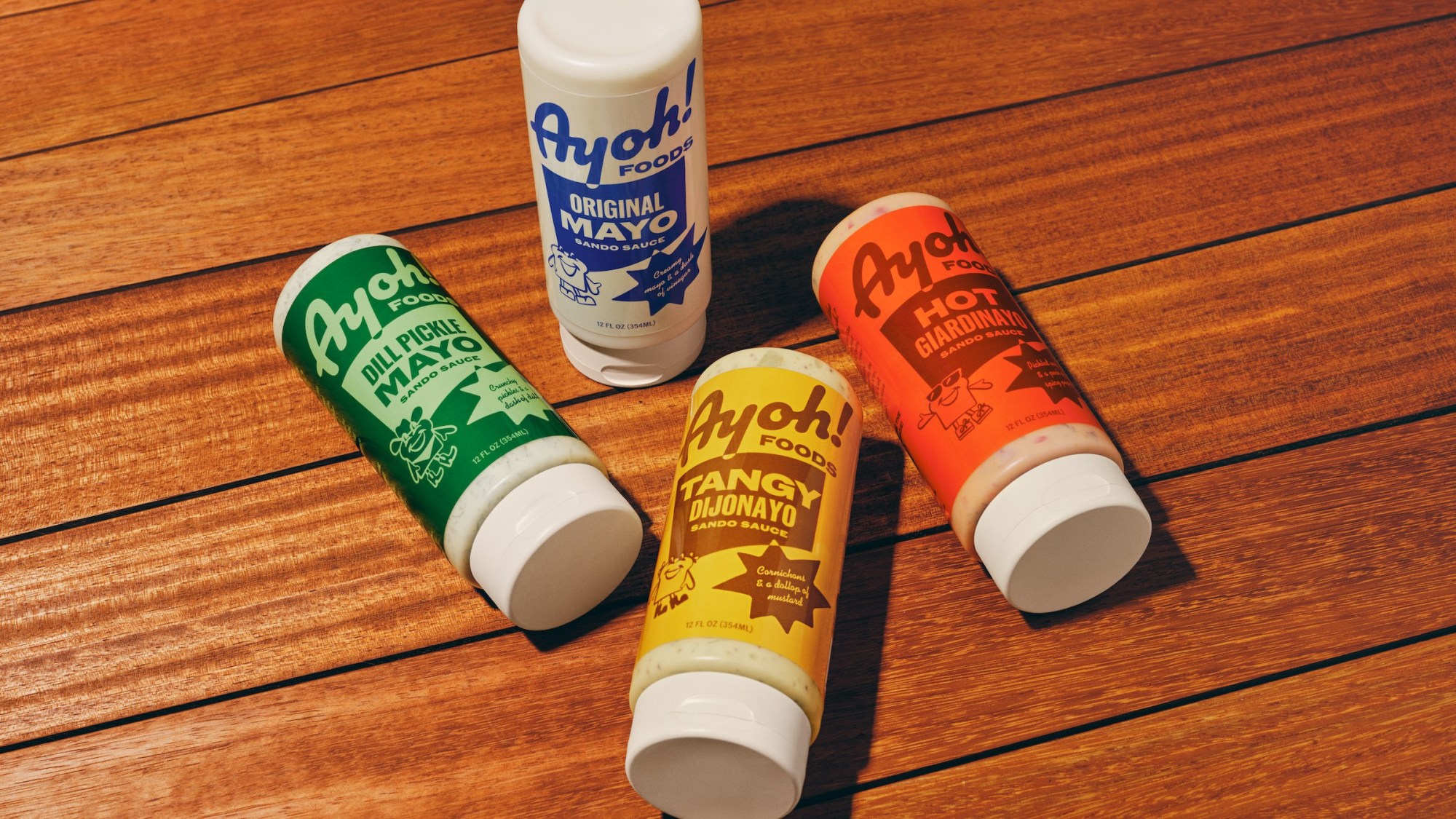
“I saw a whitespace in the marketplace where people aren’t really innovating on mayo the way they are in many other condiment categories,” Baz tells me.
That’s not to say there isn’t good mayo out there: My favorite simple version remains Acid League’s Tangy Yuzu Mayo at Whole Foods, and the New York-based brand Haven’s Kitchen launched a neat line of plant-based aioli sauces earlier this year. But I think Ayoh has something compelling going on here.
Baz met co-founder David McCormick — who’s worked as an operator, on the investment side, and spent more than seven years at Whole Foods — through mutual connections. And now they’re off, with a round of financing — around $1 million, I’m told — led by Simple Food Ventures, Lerer Hippeau, and Habitat Partners.
Ayoh launched sales online this week and will soon at Foxtrot, the Chicago-based convenience store chain, before expanding into larger grocery retailers. (Foxtrot has, itself, just relaunched, and seems to be smartly playing the role of nimble first retail account for hot startups, including the David protein bar — which flew off the shelves — and now Ayoh.)
Meanwhile, I wanted to learn more about Molly’s World, and how she’s thinking about navigating YouTube, building out Ayoh, and everything else.
Baz and I spoke recently from our homes in Los Angeles. What follows is a lightly edited version of our conversation. You can also listen to the full q&a: Become a Member of The New Consumer to get the Audio Edition feed in your podcast player.
In this interview:
- Why Baz intentionally kept her face off Ayoh’s packaging — and her ten-year vision for the brand
- The texture innovation that makes Ayoh different from flavored mayo, and why shelf-stable was non-negotiable
- How her paid recipe club became half her business after leaving Bon Appétit
- Baz’s content strategy: Why Instagram wants cheese pulls, YouTube wants tutorials, and cookbooks get what’s left
- The whitespace she identified in condiments — and why mayo is the perfect canvas for sandwich innovation
- Her philosophy on playing the YouTube algorithm game versus staying authentic
- What’s next: The longform content ambitions and why Ayoh is going on tour like a musician
Dan Frommer: Molly Baz, thank you so much for your time. I’m excited to talk about Ayoh and everything. Let’s start with how you got into food.
Molly Baz: I got a degree in art history from Skidmore, and while in college, I studied abroad twice: Once in Florence and once in Paris. During my abroad program, my interests really shifted from art history — which I was there to study — to food.
I think it’s because I was in these European cities — living there for the first time, being exposed to new ingredients and an entirely new reverence for food that I did not grow up with. I ate healthily and well growing up, but we weren’t a foodie family. Step foot in Europe and go to one market and it blows every American farmers market out of the water.
So I became very obsessed with food.
I was living with a widowed Italian grandmother in a homestay in Florence. And she didn’t speak any English, but she cooked for me every single night. And we would very awkwardly sit at the table in silence, because she didn’t understand so much as “thank you” in English. I would eat her pappa al pomodoro [a tuscan tomato and bread soup] and her minestrone and it was so fucking good.
So I started to learn how to cook by asking her to show me her recipes, which she thought was absolutely ridiculous: This is nothing! I’m just throwing scraps together and putting it on the table!” No, this is no scraps. I know scraps!
And that’s where the lightbulb went off. Those were the first recipes that I learned. And it just ignited a hunger in me to learn how to cook.
Did you work in restaurants or did you go straight into food media after that?
I worked in restaurants. I always dreamt of working at a food magazine, but I had no clue how to get there. And my logic was, no matter what my job is — whether it be that I open a restaurant in ten years, or that I am the editor in chief of a food magazine; to be a Ruth Reichl, or a food critic at the Times — I would need to know a lot about cooking.
Because no one would take me seriously if not. And so my first step was to work in restaurants and train as much as possible, so that it would set me up for success, regardless of where I landed. And that’s what I did.
I worked in restaurants for six years, maybe seven.
I ran the gamut: Everything from Picholine — do you remember that restaurant on the Upper West Side? It was a 14-course tasting menu, really snooty; everything in the dining room was velvet and purple. That was a gnarly one. And then I ended up working at Allswell in Brooklyn, a British gastropub. And from there I worked at Glasserie in Greenpoint with Sara Kramer, who now owns Kismet.
So I kind of bounced all around, and my philosophy was: Work at a restaurant until I feel like my learning curve is getting less deep and then move on to the next. And that’s what I did until I felt like I really know how to cook.
And now you — like many multi-hyphenate, internet-world people — have lots of different platforms. I guess the hub is your members club on your site, but also YouTube. How do you see YouTube as part of your repertoire? Is that the home base? Or is it just one of many outlets?
It’s one of many, and it’s honestly one that has been the hardest to crack. I have a really strong following on Instagram, which started building in my Bon Appétit days.
When I left BA, I had to launch a channel of my own — start at zero subs.
Part of what’s tricky for me about YouTube is that if you really want to be successful on YouTube, you kind of have to play the game, and you need to understand the algorithm, and you need to accommodate the algorithm. And I am slightly uncomfortable doing that, because a lot of what the algorithm demands are things that don’t feel very authentically “me.”
I kind of came up against this at Bon Appétit as well. The cooking videos, the From the Test Kitchen videos that everyone knew and loved — great. I love to teach people how to cook — that’s easy, bread-and-butter kind of content that’s evergreen.
But when we started getting into these more click-baity type of concepts on YouTube, I started to feel like this doesn’t feel very “me” anymore. For example, at Bon Appétit, they said: We’re going to do a video. It’s called Molly Tries Pancake Art, because pancake art is trending on YouTube. [the video currently has 2.2 million views.]
I did it, but begrudgingly — I’m not interested in pancake art. That’s not the value that I add to the world.
So it’s been a little tricky finding my niche there. And like you said, it’s one of many different avenues I have to reach my fans and my followers.
It’s a great one because food is so visual — it’s a great way to learn. But Instagram is visual as well. And then my recipe club is for the real hardcore fans who so graciously agree to pay for my content, which has been absolutely crucial for my ability to continue to do what I’m known for and what I’m good at. And the skills that I honed at Bon Appetit, which is to develop recipes that are very reliable, well tested, highly makeable at home.
As someone with a paid subscriber business, I know not to ask how many subscribers you have! But is it a meaningful portion of your business now?
It’s about half of it, I’d say. And that’s incredible.
When I left Bon Appétit and went out on my own, I had no real plan as to where my revenue would come from. I did have a book deal in the works. So I was like, okay — Maybe I’m just the girl who writes cookbooks. Every couple of years, I’ll get a book deal, and that is so much work already. That’ll be great. And I’ll live off of that.
And then I realized that by only writing books, no longer being on YouTube, and not having a website like bonappetit.com where my recipes were showing up, I was just kind-of going to fall off the face of the planet. You can’t just put a cookbook out every two-and-a-half years and think that’s going to float you, in terms of people continuing to take interest in your recipes.
I also just needed a creative outlet. And the recipe club has become that, where every week something inspires me, and I’m so fortunate that I get to turn that into a recipe that is then lucrative.
I’d love to hear a bit about your process. First, how do you do it? Are you constantly developing recipes? But then, when you find one, do you file it away for a cookbook? Or you say, “Oh, this one actually might pop on YouTube.” How does that all work?
I think very much in terms of these different categories, and certain ideas will thrive under certain circumstances.
There are recipes that make sense to shoot in video for YouTube, and it would never make sense to put one of those in a cookbook, because it would be far too wordy to explain how to do what is actually a simple process, but is a very visual one.
And then there’s the stuff that you know that is going to go off on Instagram. Like, I could make the world’s most delicious, refreshing, juicy, perfect salad, and no one gives a shit. What they really want is an ooey-gooey grilled cheese, or some long-cooked Bolognese recipe. Pasta, pizza, grilled cheese. It’s carbs, it’s cheese pulls, it’s food porn on Instagram.
So in order to be smart about it, you need to know where you’re dumping what content.
Where it gets tricky for me is: Right now I’m working on my third book, and there’s only so many ideas that come in any given day. Do I take that idea and twist it for the book? Or do I take it and figure out what its angle is going to be that’s going to make it interesting for Instagram or YouTube? I have to decide where it lands. Sometimes I feel like I’m just constantly serving Instagram, when really I need to be working on my cookbook.
But — Oh, that one’s gonna shoot so well! It’s gonna look amazing, people are gonna love it! And then I can’t put it in my cookbook, because I try not to repeat content. So, it does become a bit of a strain there.
When you come up with recipes, is it super random? Do you sit down and have a strategy: I’m doing chicken right now, or fish, or something seasonal. Or, does it just come to you?
It’s a bit of both.
I look at the calendar: What food holidays are coming up? What season are we in? What kinds of things are people looking for right now? What kinds of things am I interested in eating right now?
Then I look at the last five or six recipes I’ve put out. I’m not going to put out a cake three weeks in a row — half of my recipe club members probably are never going to bake.
Then from there it becomes: What little inspirations have I had recently?
I have a Notes file on my iPhone that I keep — a long scroll of chicken scratch, of little sound bites of recipe ideas that have come to me at different moments in my life.
I go to Houston’s every week, and there’s a salad on the menu there that has hearts of palm and grapefruit in it. Such a random-ass salad, but I love it. And now I want to put hearts of palm back in a salad. Why is no one using hearts of palm anymore? So that will just go into the Notes app: Hearts of palm.
Let’s zoom out. You have done a really awesome job building a world — Molly’s World — from the YouTube and the recipe club to… We have some of your mixing bowls from the Crate & Barrel collaboration; we’ve purchased your wine. Was this… Things come along and you jump on them? Or would you say you were more strategic about building out this world one piece at a time?
I’m pretty strategic about it. I think about what I’m doing, where I’m going, where I’m heading, what parts of my business need more attention, where I’m over-indexing. I think about this all the time.
I have this overarching philosophy, which is that I’m here on this earth to either teach people how to feed themselves, or to feed people directly, and sort of infuse deliciousness into the world through one of those two avenues. All of the things that I do are in service of fueling one of those two pillars of my mission statement here.
And so, the wine company, for example — I want people to have affordable, accessible, unpretentious, delicious natural wine at their fingertips, where they can walk into the store and they’re like: I know that Molly fucks with this, and I know it’s going to be delicious, and I don’t really know anything about wine, but we’re good here — I’m gonna bring it home.
And the Recipe Club is a place where I get to teach people how to feed themselves, and my cookbooks and YouTube are the same.
So the one part of my business that has been lacking a bit — because I’m not really interested in opening a restaurant — is that opportunity to feed people directly. That’s where the CPG play comes in, and why I’m launching Ayoh.
I think there’s a large portion of the population who knows who I am, and maybe thinks my food looks yummy, but is just never going to get in the kitchen and start cooking. They’re just like, I don’t cook. It’s not my thing. I love to eat. I know good food. I’ll seek it out when I’m out in the world. I travel for food. But I’m not a cook. And those people, I think I miss by not having as much of a contact point with them, since so much of what I do is teaching people to cook for themselves.
So Ayoh is my foray into creating products that deliver food straight to people’s mouths, basically.
And because Ayoh is a line of mayo gone wild, as we call it, or sando sauces… Sandwiches, for me, aren’t filed under cooking. I know plenty of people who won’t spend time making a roast chicken, but are in their kitchen slapping together a turkey sandwich in the middle of the day. Ayoh is meant to meet them where they are.
What was the path to Ayoh and condiments? You described some of the strategic thinking, but there’s oil, there’s sauces, there’s so many things. How did you land on condiments and mayo specifically?
During the pandemic, I became obsessed with sandwiches — I think out of boredom, and because it was one of those items where, when most restaurants were closed down, the sandwich shops were still cranking out sandwiches, and I was eating a lot of sandwiches, and a lot of bread, and I just didn’t care.
I started a sandwich podcast during the pandemic with one of my best friends, where I would do deep dives on sandwiches. So that centered me in this sandwich space and got me thinking about sandwiches a lot.
I started to notice this trend where there are such incredible sandwich shops out in the world — every city has a bomb-dot-com sandwich shop or countertop — and sandwiches are like twelve, fifteen, sixteen bucks. And then you try to make a sandwich at home, and it absolutely never hits like the good sandwich shops do.
That’s because sandwich shops have the time and resources and staffing to make everything in-house, and make everything special for each sandwich, and spend time pickling their own peppers and onions, and making their own pesto spreads and Calabrian chili whatevers.
And no one’s going to do that at home. No one’s putting that time and effort into making a sandwich. Sandwiches are meant to be on the go, on the run. So I wanted to solve that problem in the world.
Mayo is one core ingredient of pretty much every sandwich in the entire world. Most people, when they make sandwiches at home, just grab the regular mayo, the plain mayo, whether it be Hellmann’s, or Best Foods here on the West Coast, Duke’s, Kewpie, whatever their brand is. And then, at the most, they add mustard to it, and that’s where the journey ends.
Because it is basically 100% fat, and fat carries flavor, mayonnaise is a substance that can contain many other ingredients.
I saw a white space in the marketplace where people aren’t really innovating on mayo the way they are in many other condiment categories, and categories in general. You see a couple of flavored mayos here and there, but it pretty much stops at spicy mayo, and maybe you’ll see a lemon mayo here, or a sriracha mayo.
Let’s push this further. It’s a canvas for flavor.
Let’s not just make flavored mayos, let’s make textured mayos. Let’s put all of the bells and whistles of a great sandwich right into the mayonnaise bottle, so that people can just open up their fridge, open up a bottle of Ayoh, squirt it on, slap on some meat and some lettuce and tomato, and they actually have a transformatively delicious sandwich, akin to what they might expect out at a sandwich shop.
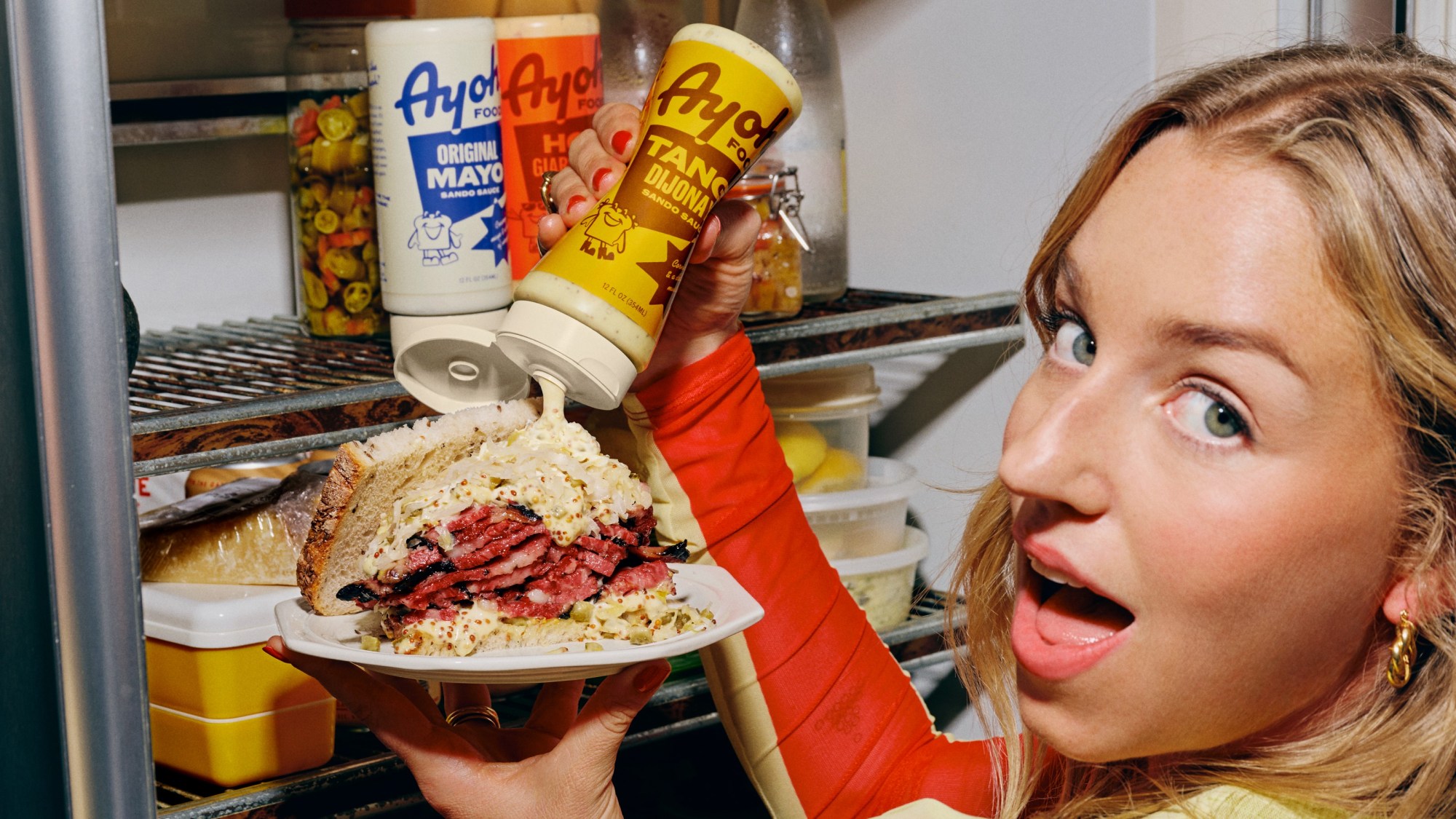
Let’s go through the flavors. The way you describe it, the texture was what surprised me. You have a standard mayonnaise, which tastes like mayonnaise. But the Ayoh secret sauce is probably some of the flavors. What are you launching with, and what do you love about them?
We’re launching with four SKUs. One of which is just creamy mayo, because we think that we can compete with the best of them, and people still need regular mayo. But the other three, which is really what we’re all about, are Dill Pickle Mayo…
Dill pickle is very zeitgeisty right now. You can get anything dill-pickle-flavored at this point — except for mayo, until now. It felt like a important opportunity. And everybody puts dill pickles on their sandwich. So it felt like a very obvious mayonnaise sandwich play to me.
There’s chunks — there’s, like, legit chunks of pickle, and a bit of spice to it as well.
There’s mustard in there, too, so you don’t have to go reaching for mustard. Mayonnaise, dill, lots of chopped up dill pickles. There’s other spices in there, like onion powder, garlic powder, other secret ingredients.
And the other thing about it, which holds true for all of these mayonnaises, is that they have a pretty high acidity component. There’s vinegar and vinegar powder in these recipes, which make them really bright on your palate. Which is an unexpected experience when it comes to eating mayonnaise, because mayonnaise is normally just fatty and round. But the key to a great sandwich is not just fat, but also a balance of acid.
It’s so good on a turkey sandwich, but even moreso, I love it as a one-stop shop to making tuna salad. Dump it into a bowl with a can of tuna, mix it up, and you’re done. That’s a great cheat for making tuna salads or chicken salads at home.
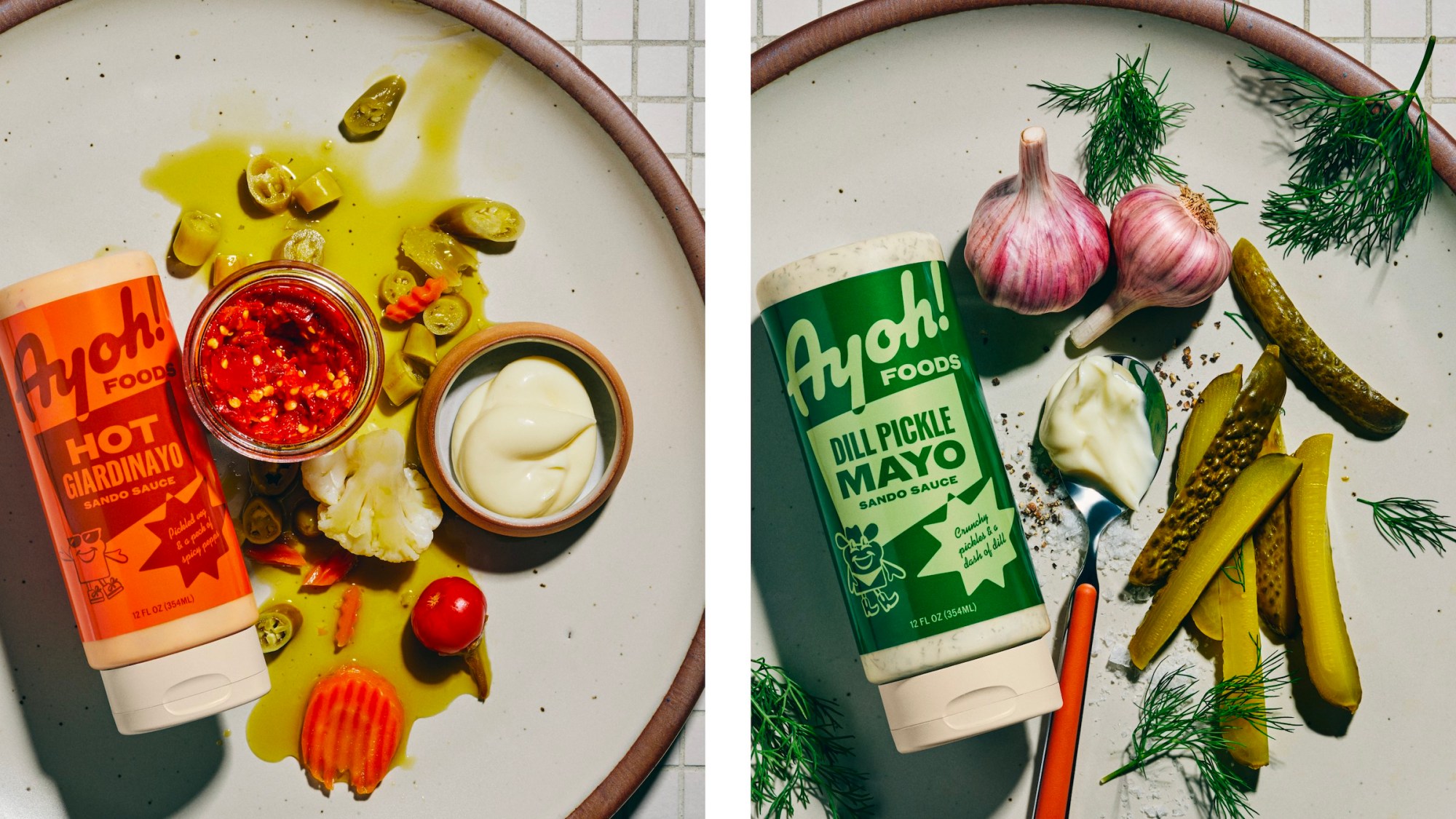
And then we’ve got Hot Giardinayo, which is kind of where it all began.
I had a lightbulb moment a few years ago with my manager and very close friend, Ben. We were making sandwiches, or talking about sandwiches, talking about the sandwich podcast.
We were at home making hoagies, and we reached for the giardiniera because we both love giardiniera — we love pickled vegetables, we love spice. And then we reached for the mayonnaise, and we both looked at each other, and we’re like: Oh my god — why is nobody putting hot giardiniera in mayonnaise? This is the billion-dollar business the world is missing.
That was the starting moment, the little spark of Ayoh, where we thought this condiment, in particular, could change the game.
I ended up developing that on my countertop at home. It’s got Chicago-style giardiniera, Calabrian chili peppers, pickled cherry peppers, and then a bunch of other spices and vinegars and ingredients in there that make it spicy and bright and pickly and peppery. It’s exactly what your hoagie wants.
I mean, I’ve used it a million times. But I made a hoagie yesterday, or two days ago, with it, and I was again hit over the head with, like, the world has been missing this — this is the answer to a great hoagie, period. So that’s kind of our hero flavor.
And then the last one is the Dijonayo. Many people are familiar with Dijonayo as a condiment — it’s a mashup of mayonnaise and mustard, basically. But ours is a mashup of mayo, Dijon mustard, and then tons of pickled mustard seeds. So there’s these little pops of pickled mustard seed throughout.
And we’ve also added in chopped cornichons — those little baby French pickles — so there’s a ton of texture in that one. It’s really a complement to any kind of French-style ham and cheese, or turkey and cheese sandwich; great on a baguette, salami and cheese. It has that more classic sandwich flavor profile.
I just tasted them. They’re really good — they don’t taste like shelf-stable products. They have a lot of depth to them, and a surprising — I would say appropriate — amount of spice. Probably not easy to do on the first shot. What this process has been like? How did you figure out how to make this?
Well, it started in my home kitchen. And I know enough about building businesses to know that I cannot do it all myself, nor should I — that I have certain strong suits, and not to try and play in other lanes. So I pretty quickly found a business partner.
David.
Yeah, David, who we met through some other industry contacts.
I’ve been in conversations with people about launching a CPG line for a while, and there’s been many iterations of what it would look like. Along the way, I got connected to David through one of those conversations, and he was suggested as someone who would be an incredible operator, business partner, a guiding light.
He’s worked on many sides of this business: He’s helped build brands. He’s invested in brands. He’s helped on the grocery buying side. So he kind of knows all the touch points of launching a CPG brand and what is required to do it successfully. And he has shown me the ropes, basically, because he’s done it a million times before.
So we basically took my recipes and then had them commercialized. He found a partner that worked on making sure they were executable at a commercial level, using commercially available ingredients.
We did many, many rounds of virtual tastings with them — I think we did nine versions of tastings at that level. And then we moved it up to a production facility, our co-packer, where we started to run tests there of really making this product at scale. So now we, in the last couple of months, have been at the phase of producing it in 2,500-pound batches. And making sure that everything still tastes as it did on bench and is at the same quality.
I’m going back next week for our final production run, which is where we’ll produce the first — I guess it will be, I don’t know, many, many tens of thousands of pounds of mayo, and bottle it all, and then launch on November 18th.
I saw a very early version of the packaging — one of my kind readers leaked me an investor deck a while ago. I see the brand has evolved, I see the packaging has evolved.
I see your face is not on the label in the front and the center. How Molly does this need to be? How central to the brand do you feel like you should be?
It’s a great question, and something I’ve thought a lot about.
I very intentionally did not put my face on the bottle, for a couple of reasons.
Number one, I get this feeling, when I see a celebrity’s face on a product, that they got some nice deal to endorse a product that wasn’t really actually their idea, conceptually, to begin with, and they just got cut a check.
Ayoh is not that. Ayoh is me spending hours and hours thinking about: What does the world need in the condiment space? Why don’t they have this product already? And how do I make it happen? As a cook, I think it’s an important product, regardless of whether I’m attached to it.
So part of it was not wanting Ayoh to feel like a celebrity-endorsed product line, but for it to feel like a heritage brand that could live on, and live in people’s fridges and on their countertops for a really long time.
My ambition for Ayoh is that in ten years, fifteen years — ideally sooner, but let’s not be greedy — people are referring to Ayoh in the same way that they refer to Hellmann’s and Heinz. And that it’s got brand recognition of its own that far outweighs my participation in it. Where someone who may not even know who I am still fucks with Ayoh, and it is a household ingredient across the nation — hopefully beyond that. And it ultimately has less to do with me than to do with the quality of this brand.
But in its nascent stage here, I’m very tied to it. I will be launching Ayoh on my platform. I am in a lot of the photography. I’ll be promoting it. Everyone will learn about it via my Instagram and my platform and my promotion. But ultimately, I believe that Ayoh will sail off on its own and be bigger than me. That’s the goal.
The way to win, at least early stage CPG, is very much a ground war — a lot of in-person stuff, tastings, that sort of thing. Are you ready for that? It’s book tour times ten, maybe.
Yeah, totally.
I have another industry friend who ran a totally different business, also a grocery product. One piece of advice, he said, is that the most important thing you can do is show up in the grocery store aisles and connect with customers, and be in their face, and taste them on the product right then and there, and talk to them about Ayoh. So I very much intend for that to be a part of our business plan and how we become really trusted by our customers.
Luckily, I also have a big platform that I can use to talk to people when I’m not physically in their stores. A lot of the content that I’ll be creating, which I’ve already started, is, like, how to use this stuff. What are the ways that I’m using it? Sandwich inspiration, other inspiration.
Where is the Cae Sal SKU?
Great question. It is not the first, because, first of all, we’re focusing on sandwiches.
Obviously, Caesar salad dressing is a mayo-based dressing. I hope that with Ayoh’s success, we’re able to then launch other lines under this umbrella that we’ve created. Salad dressings will be one of the first things we explore there.
The thing about Caesar dressing, at least for me, is that in order to create a Caesar salad dressing that is really as delicious as the homemade one, it involves a certain element of fresh ingredients that don’t translate well to shelf-stable. So that’s a hurdle that I will need to overcome. And we’ll r&d it when the time comes.
But for now, I didn’t want to create a line of mayonnaises that didn’t live in the mayonnaise aisle, because that’s where people expect to find them. And I didn’t want a refrigerated mayo, because it’s just not human behavior to look for it there. So when we do salad dressings, we will open that can of worms, and of course Caesar salad will be one of the first things I tackle.
In terms of sales, you’ll launch online. Do you have any grocery stores lined up for launch, or small shops?
It’ll be, on day one, online. And then almost immediately, we will be in-store at Foxtrot in Chicago — that’s our first retail partner. I have a relationship with them through my wine company, Drink This Wine.
Then we will quickly start to secure accounts in lots of little shoppy shops around the country — little gourmet stores and sandwich shops. And then Q1 of next year, our intention is to go pretty hard on grocery, and find ourselves one or two big, nationwide grocery partners.
My real mission for Ayoh is not that it be an elitist, coastal, expensive product that’s available in gourmet shops, but that it’s on the shelves of every Ralph’s, Stop & Shop, Wegmans, what have you. I want it to be a product for the people.
Your YouTube channel launched during the pandemic, when we all had unlimited time to cook. And, still, some people spend hours in the kitchen, but decreasingly. I saw a stat recently — something like, the only the only thing growing is home meals that take under 30 minutes to prepare.
You probably get a lot of reader feedback. How are people cooking now? And does that factor into how you develop recipes? Does that factor into how you developed Ayoh?
Totally.
There are a lot of people who either don’t want to cook, or just don’t have the time, and Ayoh is a great solution-slash-cheat for that. Whether you’re making sandwiches and you’re just making better sandwiches now, or that you’re pulling out the dill pickle mayo — the dill pickle Ayoh — and adding fresh lemon juice to it, whisking it together, and turning that into salad dressing, that’s making cooking a lot more accessible.
Like you said, people have less time, and also less bandwidth and attention span for cooking, because our brains are severed and pulled in a million directions, and we’re in front of screens all the time, and we want that instant gratification.
I’ve totally noticed a trend of people wanting less fussy, less ingredients, less time, for the most part, in terms of their recipes. Luckily, Ayoh fits right into that trend. And the next book I’m working on right now is sort of an answer to all of that, as well.
So, yes, I am aware of it. I am watching it. I know that I live and breathe cooking, and for me on a Tuesday night, no problem to make a pot of chili. But for a lot of people, that would be a gargantuan task. And so I do think about it a lot, and a lot of my content, as we move forward, will reflect that.
One other thing I’m curious about: This is an era of maybe too much feedback, and it’s in real time and it’s not always nice. Do you look at the YouTube view counts and go: “Oh, this really popped. I should do more like this!” Or: “This recipe drove a ton of signups on the newsletter, better do more like that!” What sort of feedback do you actually use in your work?
I definitely pay attention to the metrics.
Also, it’s important to remember that just because a piece of content got a ton of views, or a ton of likes on Instagram, doesn’t mean that a ton of people are making it. There is a category of content where people just want to see you make something that looks really elaborate and delicious, but they’re really never going to get off the couch and do it themselves.
Again, my mission is to actually encourage people to cook, and not just create aspirational content where they’re like, “Oh, that looks like a horny pot of chili, but I’m never going to make it myself.” So it’s a balance.
I saw your chili posts—
I’m in a big chili mode right now. I’ve had chili twice in the past week, and for whatever reason, the only comfort I can find in this world is chili. And I guess my baby’s cheeks, but that’s a pretty lethal combo—
I want to ask you about that actually. I have a son, he’s three and a half. I cook all his food, and it’s changed the way I cook and eat. I know yours is younger — I don’t think he’s eating solid food yet. But has that yet changed the way you think about cooking or what you eat?
Definitely. He’s not eating solids yet, but he is tasting things, which has brought me — Actually, funny enough, we kind of had a little powwow, my husband and I, about what our approach to introducing foods would be. If you read any advice, people recommend you start with, like, avocado, mashed banana, these easy, mushy, lightweight foods, mellow vibes.
And, I was like, no! My child’s first food is sure as hell not about to be a piece of avocado. I don’t even like avocado. And so I gave him a dill pickle. And he loved it and he grabbed it. I, of course, gave him one that was big enough that he wouldn’t choke on it — I’m not a monster. But it was a baby dill pickle and he grabbed it was after it for five straight minutes.
He didn’t make a sour face. He didn’t spit it out. Which gave me a lot of hope for our future. And for his palate, although I’m sure he’s a little too young to say.
But I think that I’m excited to experience the world of food again through his eyes and see where that takes me. And I’m sure that my content will reflect the fact that I’m a mom at home, feeding a child. But I don’t want my platform to be mom food. It’s just too alienating. It’s definitely a huge portion of my readership and fan base, but I’m also interested in continuing to inspire everyone.
I think we’ll see a bit of everything in the future. And I’m sure that people will have a lot of judgment around the way I choose to feed my child, which will be entertaining!
Cereal with ice cubes.
Yeah, exactly.
Launching Ayoh will be very demanding. As you think about the Molly World, are there other things that you want to do? Don’t want to do? Do you want a tv channel? Anything super interesting to you?
I want to find my way on — TV maybe isn’t the right way to describe it, but a longform content piece, streaming situation, or TV. I want to find my show, my niche, and I want it to be something that allows me to share my personality a bit more.
Shortform content, everything gets edited out. You can have a ton of personality, but no one really gets to know you, because everything is less than 60 seconds.
My YouTube show gets to see inside my world, but it’s a very traditional, stand-and-stir cooking show at the end of the day. Part of what fuels me in life is my relationships with people and interacting with other people over food, around food, over cooking.
So I do want to figure out what my way in is in the longform content arena — a show that can live on for a long time, and I can really be me, and lots of people can come through, and there can be plenty of guests and interactions, and a lot of vibrancy and personality.
Last thing: Were there any brands — either brands we grew up with, or brands that you’ve seen take off in the last few year — that either inspired you, or that you’re borrowing some of the playbook from with this launch?
We really intentionally tried to look away from what’s popping right now in CPG — in terms of branding, brand identity, ethos — and looked backwards and payed homage to sandwich shops and counter lunch places; countertops of yore.
The Ayoh branding, if you saw our moodboard deck, it’s basically all imagery pulled from Americana from the last 60 years, of old milk cartons and sandwich shops and pastrami counters.
Ayoh is very much inspired by a more retro moment in American history, where things were simpler, because it’s mayonnaise, and it’s such a fundamental, core product in the American pantry. And we didn’t want it to appear as this new, trendy condiment, when really it’s been around forever, and we all know and love it, and it belongs next to ketchup.
In terms of branding and everything, we’re very inspired by the past. And then marketing wise, we will try to carve out our own little niche that looks to the future.
Anything specific I should look out for on that front?
Well, we are launching Ayoh with a community driven sandwich tour. Ayoh will launch on the 18th, and then pretty soon after, Ayoh, as a condiment, will be going on tour, much like you would expect to see a musician go on tour, except it’s mayonnaise on tour.
We’re going to have Ayoh popping up at well-known, beloved sandwich shops around the country, doing one-day takeovers of the menu, where those sandwich shops will receive Ayoh, play around with it, make special Ayoh-specific sandwiches and menu items. And people can come together, taste Ayoh, and hang out, and just have it feel like a way to bring people together over sandwiches. That tour will launch in November, and last as long as possible.
My other business partner — who’s my manager and other partner in Ayoh — is a talent manager, but he manages mostly musicians. And then he happens to manage me and a couple of other people who are outside of the music industry. But we’re very much in this music industry world. He’s sent a ton of artists on tour, so we thought it would be fun to send Ayoh on tour.
Molly, thank you so much for your time. I’m excited for this one. It’s genuinely delicious. So we’ll see how it goes.
I’m so glad you like it — thank god. Imagine you got on here and were like, “I have a bone to pick with you. This shit sucks.” Well, thank you for having me. It’s been a pleasure.
Hi, I’m Dan Frommer and this is The New Consumer, a publication about how and why people spend their time and money.
I’m a longtime tech and business journalist, and I’m excited to focus my attention on how technology continues to profoundly change how things are created, experienced, bought, and sold. The New Consumer is supported primarily by your membership — join now to receive my reporting, analysis, and commentary directly in your inbox, via my member-exclusive Executive Briefing. Thanks in advance.