
Executive Briefing
Is smoking really back?
Sorry to disappoint. Plus: The Quince growth chart revealed, and seven years (!) of The New Consumer.
 By Dan Frommer on Thursday, March 26, 2026 at 10:30 am

Hello hello! It’s Dan Frommer, back with The New Consumer.
Last weekend, on March 21, The New Consumer turned seven years old. It’s been a while since I’ve reflected much about the site/newsletter/business itself — who has the time?! But I want to say THANK YOU for supporting my work; for reading and replying; for asking me to speak at your events and offsites; for hiring me on advisory projects; for sharing my slides and charts; for making this whole thing possible.
This continues to be the best job I’ve ever had, and I’m more excited about the year ahead than I have been in a while.
If there’s one thing I’m most proud of from the past few years, it’s the growth of my Consumer Trends research series with Coefficient Capital — easily the most “me” thing I’ve done with The New Consumer, and maybe the most successful thing I’ve created since helping start Business Insider 19 years ago. We plan to publish four main reports again this year, plus a new micro report — stay tuned. And I’m working on making it easier for you to browse the archives and get more use out of all that research and data.
In the meantime, the best way to support my work is to become a member, add colleagues by upgrading to a team plan, or reach out about speaking, consulting, or brand partnerships. Thank you again!
“Cigarettes are back!” the New York Post has declared.
“From trays filled with cigarettes at the Vanity Fair Oscar’s Party to Kylie Jenner smoking on the mag’s latest cover,” Allison Lax wrote last week, “…smoking is well and truly back — Surgeon General’s warnings be damned.”
This has been coming up more in conversation: After all that wellness posturing, are young people really smoking?!
On a mass scale, no.
In mid-2025, 11% of Americans said they had smoked a cigarette in the past week, tied for the lowest percentage ever, and down by nearly half from a decade ago, according to Gallup, which has been conducting this survey for more than 80 years. That percentage has been in decline since the 1950s. And while it moves a little year to year, the overall trendline is that fewer people are smoking, not more.
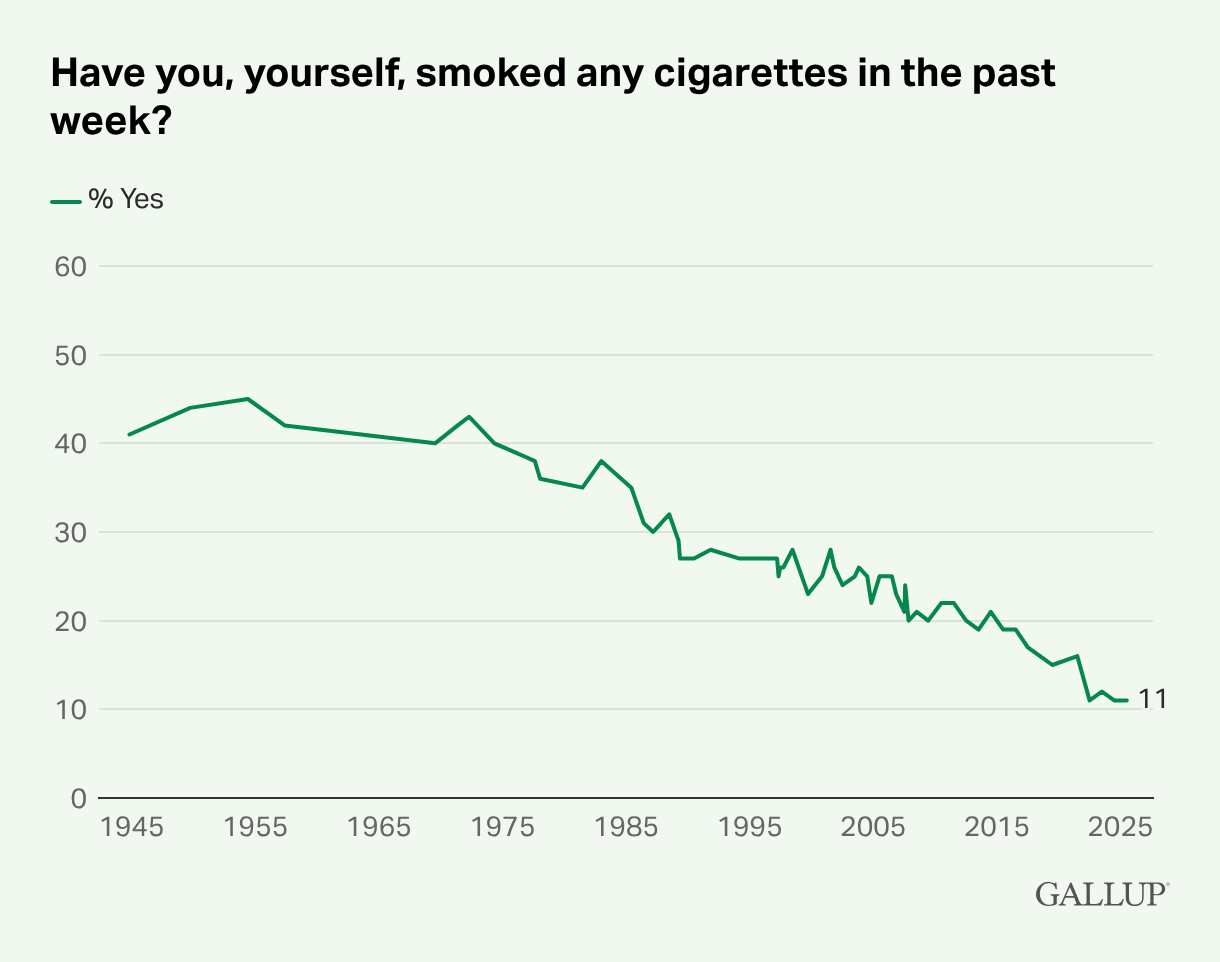
The smoking rate is even lower among young Americans, both in comparison to young people in the past and to older consumers today, according to Gallup’s polling.
In 2024, Gallup’s Jeffrey M. Jones wrote that “Over the past three years, an average of 6% of adults under age 30 say they have smoked cigarettes in the past week, compared with 35% of young adults in 2001 through 2003 surveys.”
“Young adults are now less likely than other age groups to smoke cigarettes, as 13% of those between the ages of 30 and 49, 18% of those aged 50 to 64 and 9% of those 65 and older say they smoke.” (Young adults are more likely to vape than smoke.)
What about actual cigarette sales numbers? Those, too, continue to decline, as fewer people smoke and as higher taxes continue to make cigarettes more expensive.
Here’s a link to a slide deck from a nonprofit website called Monitoring Tobacco Product Use, published this month and citing full-year 2025 data from Circana, the market research firm that tracks retail sales.
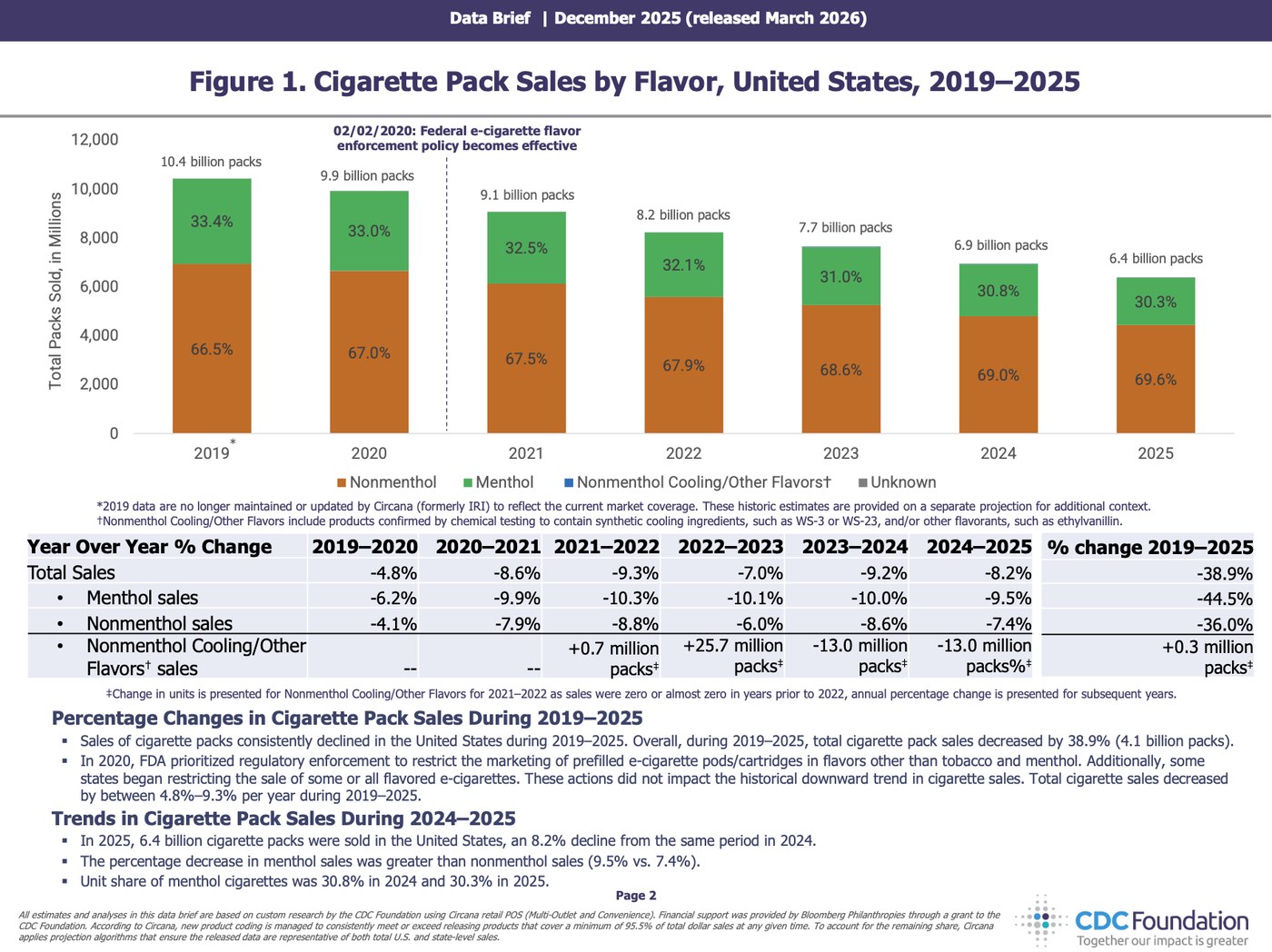
Cigarette sales fell to 6.4 billion packs in the US last year, down 8% year over year from 6.9 billion packs in 2024 and down 39% from 10.4 billion packs in 2019. Cigarette pack sales declined 10% year over year in California and 7% in New York in 2025, according to the report.
So if cigarette sales are down, and smoking is down, why is it also “well and truly back”?
I think there are two things going on.
One is that, yes, among a certain, small set of culturally visible bicoastal elites, cigarettes are showing up — ironically or not — in more public situations.
The Post story doesn’t cite numerical data, but the perception is real. I’ve heard it from friends, seen it myself, and have had investors mention it in conversation.
Over the past couple of years, for instance, I’ve watched people who wouldn’t consider themselves “smokers” have a cigarette or two after dinner or at parties or on a walk, in a way they probably wouldn’t have a decade prior. What was once considered just stupid is now considered stupid but kinda cheeky, so why not? That’s not enough to drive real pack sales growth or even that much more actual smoking. But it’s enough that you notice it.
In our latest Consumer Trends survey, conducted last month by Toluna, my research partners at Coefficient Capital and I asked 3,000 US consumers how smoking cigarettes affects someone’s “image or vibe.”
Around 23% of Gen. Z and Millennial respondents, ages 15–45 in our panel, said smoking makes someone seem at least somewhat “more cool or appealing,” compared to just 6% of Gen. X and older consumers. Younger people were also less likely to call cigarettes “very unhealthy” — 60% for Gen. Z and Millennials vs. 84% for Gen. X and older.
We don’t have our own historical data to show how those numbers change over time. But it’s a notable generational gap, which helps explain the perception, even as actual smoking rates remain at historic lows.
And that is the other thing — the noticing it.
During those decades when smoking was on the sharp decline, it felt like it. Now that it’s plateaued at a historically low level, when cigarettes show up next to the crudité platter, or when the person walking in front of you is leaving a trail of smoke, it’s more noticeable.
Plus, there have always been “social smokers.” The difference now is that a decade or two ago, more people were actual smokers, so the occasional ones were less obvious.
Will that cultural visibility — in Hollywood and among the How Long Gone set — drive an uptick in actual smoking? Again, anything is possible, and the numbers have fluctuated over the decades. So maybe a tiny bit if enough people get addicted by accident. But I doubt we’ll see a profound reversal.
The growth chart worth $10 billion
Quince — which sells simple-looking, Premium-Economy basics across a bunch of clothing and home categories — was not the first venture capital-backed startup trying to disrupt the apparel industry with direct-to-consumer e-commerce. But it’s the rare one that’s working.
Quince grew rapidly last year, roughly doubling, according to US consumer credit and debit card transaction data provided by Consumer Edge. In the fourth quarter of last year, growth accelerated and it even overtook Uniqlo. And it has long zipped past Everlane, one of our favorite elevated-basics concepts from the early DTC era.
Chart of the Day
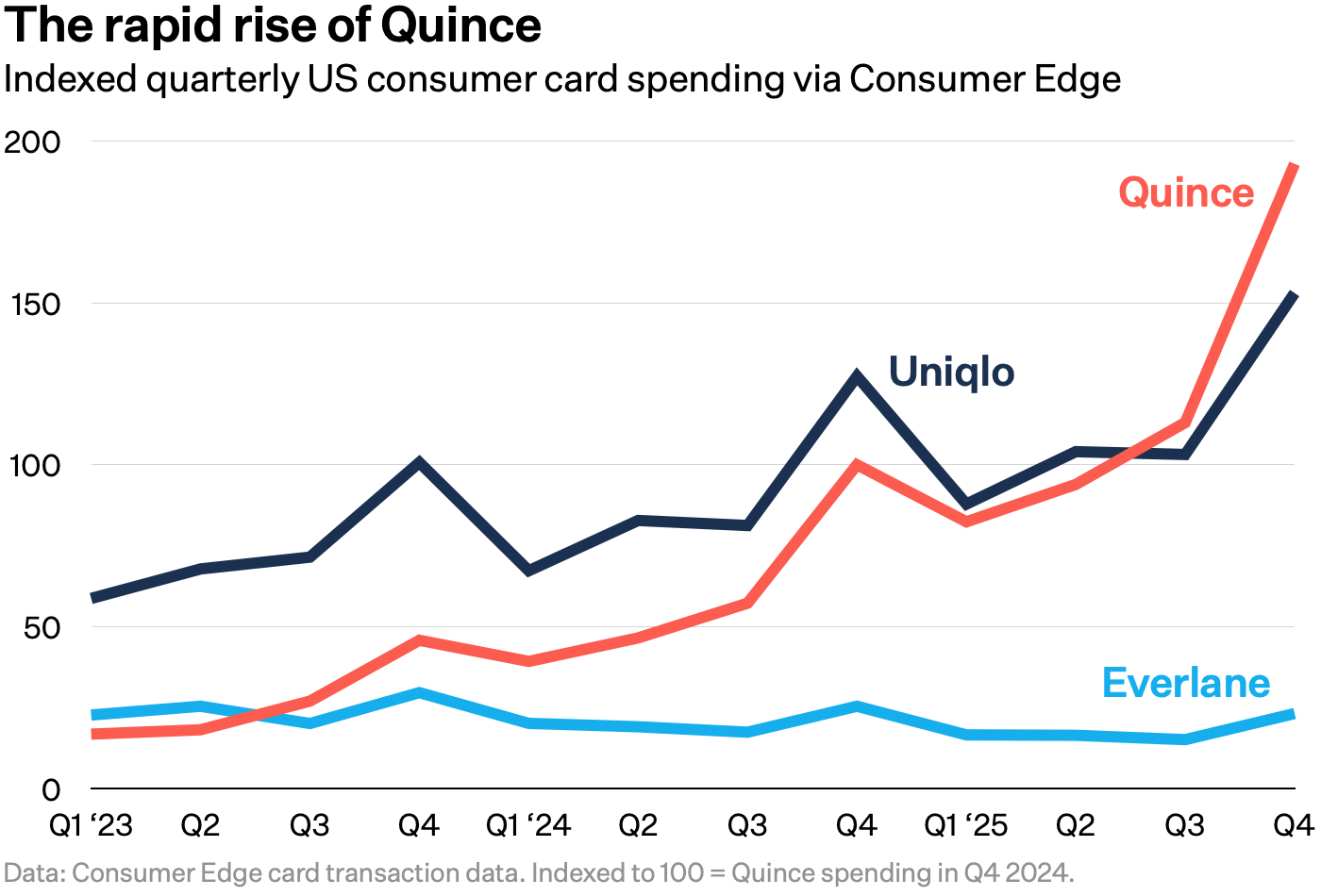
Quince’s whole thing from the beginning has been a “manufacturer-to-consumer” model: It moves inventory and product design closer to the source of production, and strips out a lot of the corporate middleman role that defines but bloats most fashion brands. My notes from our first call in 2021, when they were already savvy enough to hire Derris for PR, include “Democratize access to nice things” and “Bloomingdales meets Costco.”
The story since then is that Quince became famous for a $50 cashmere sweater, and has expanded into nearly all categories of apparel and accessories, plus luggage, jewelry, and now beauty and wellness. The products are good enough that they’ve won praise from the likes of the NYT’s The Wirecutter and NYMag’s The Strategist. I imagine the affiliate action is also strong, which helps secure pieces like this one from Who What Wear.
This growth has allowed Quince to raise a lot of capital, including another $500 million round announced earlier this month, led by Iconiq — which manages tech billionaires’ money — that valued the company at $10 billion.
In a blog post rampant with jargon, you can see why a firm like Iconiq loves Quince: “Its integrated, technology-enabled supply chain leverages data and AI-driven product development and small-batch production to help reduce waste, limit markdowns, and create structural cost savings that are passed directly to consumers.”
I’m fascinated with Quince because I’ve found it surprisingly polarizing as a brand.
It is clearly the sort of thing — cheap versions of simple, nice-looking things, ostensibly with some quality — that a lot of people want. Even as it adds new customers rapidly, existing customers are now driving the majority of its sales, and are spending more on a per-account basis, according to Consumer Edge transaction data. By focusing on operational efficiency, it’s built something that mainstream consumers and tech-forward investors are both happy to pay for.
But among those around me who care about status and brand, Quince is deeply uncool. Curiously, these are some of the same people who will gladly brag about wearing Uniqlo under their Phoebe or Auralee.
Perhaps because the same thing that’s made Quince successful — efficiency, anonymity — just feels bland. It’s not nearly the cynical, cheap-crap-from-China concept like Shein or Temu. But it’s still missing story and any attachment to culture. Unlike the brand worlds built by Uniqlo (collabs with designers, connection to Japan) and Kirkland (native to beloved Costco, “dad brand” meme status), Quince still feels like it was made by a spreadsheet and data-mining operation, not by designers or merchants.
So it’s interesting to see Quince try to do more “brand” things, including putting its name and logo on supplements and fragrances, collaborating with A$AP Rocky, and hiring its first head of brand strategy. It might not matter — the market for middlebrow basics will always be huge if you can nail the unit economics. I wonder if Quince can eventually build the kind of brand that people feel something about, not just buy from.
Also on my radar:
United Airlines, a ~decade removed from dragging a passenger off one of its planes, is enjoying a narrative in some circles that it’s passed Delta as the smartest, most premium US-based airline.
United is at least trying new things, such as a new seating option it’s introducing on some planes next year called United Relax Row. That is: “Three adjacent United Economy seats with adjustable leg rests that can each be raised or lowered to create a cozy lie-flat space for sleeping, stretching out… whatever you want – it’s your row!” The feel-good Instagram Reel announcing it has passed 2 million views — much higher than its average.
Fun idea, and for a solo traveler, or parent and toddler, maybe a nice bed over the ocean. (Not yet announced: How much it will cost.) But it’s easy to forget how small that legroom area is — this might be a letdown.
On Running has been one of the shoe companies most responsible for Nike’s recent decline, taking share on the high end of the running market and doing smart lifestyle collabs with the likes of Loewe and Beams. But its shares just hit 52-week lows after its second CEO change in a year and a lower-than-expected forecast for 2026 sales. Nothing a few good quarters can’t fix. But I’m not sure I could articulate what sets On apart, other than its novel sole design and seemingly high build quality. Product and brand work ahead.
Fishwife, the tinned fish startup I first wrote about in 2021, is doing great, and continues to do an excellent job making its product lineup and brand feel alive. Rachel Karten has a new look at how Fishwife “builds momentum through newness.”
Opening Day is here — a great time to read (or re-read) my feature from last fall on Obvious Shirts, your favorite sports fan’s favorite t-shirt company. In gratitude for the Cubs extending Pete Crow-Armstrong’s contract, I’ve temporarily removed the paywall. Enjoy and feel free to share!