
Executive Briefing
How consumers are using — and thinking about — AI right now
Gen. Z uses AI more than any other generation. They’re also seriously skeptical.
 By Dan Frommer on Friday, September 26, 2025 at 8:00 am

Artificial intelligence, or AI, is increasingly part of everything, from digital interfaces to casual conversation. It’s still early, but as it develops, AI has the power to profoundly change many aspects of life.
How are consumers using AI today? And how do they think about it? This was a major topic in our latest Consumer Trends report with Coefficient Capital, which I presented last week in New York at the BRXND AI x Marketing conference.
Today I’m going to unpack key parts of our research, plus some great new data from OpenAI.
The big picture
- AI is something almost everyone knows about, and many people — especially younger consumers — are already using on a regular basis.
- Consumers are mostly using AI today for advice and guidance, writing, and research. There’s no single dominant use case for ChatGPT or other AI tools, but instead many different ones, highlighting their versatility.
- AI tools aren’t the top resource for shopping and commerce recommendations, but they’re increasingly part of the picture, especially for younger consumers.
- In the US, Gen. Z expresses less optimism and more negativity about AI than Millennials, who are the most positive generation in our survey. Older consumers are even more pessimistic.
It’s early, but AI awareness is already as mainstream as it gets
Almost all Americans (98%) have heard of AI, and the vast majority of those (93%) have heard of at least one modern AI tool,
such as ChatGPT or Claude, according to our recent Consumer Trends survey of more than 3,000 US consumers, conducted in July by Toluna. For context, that’s higher than the portion of consumers who say they’re aware of TikTok or Doritos.
Perhaps the best snapshot of the rise of AI is this chart, based on new research published by OpenAI — the company behind ChatGPT, the most popular AI chat tool — and the National Bureau of Economic Research.
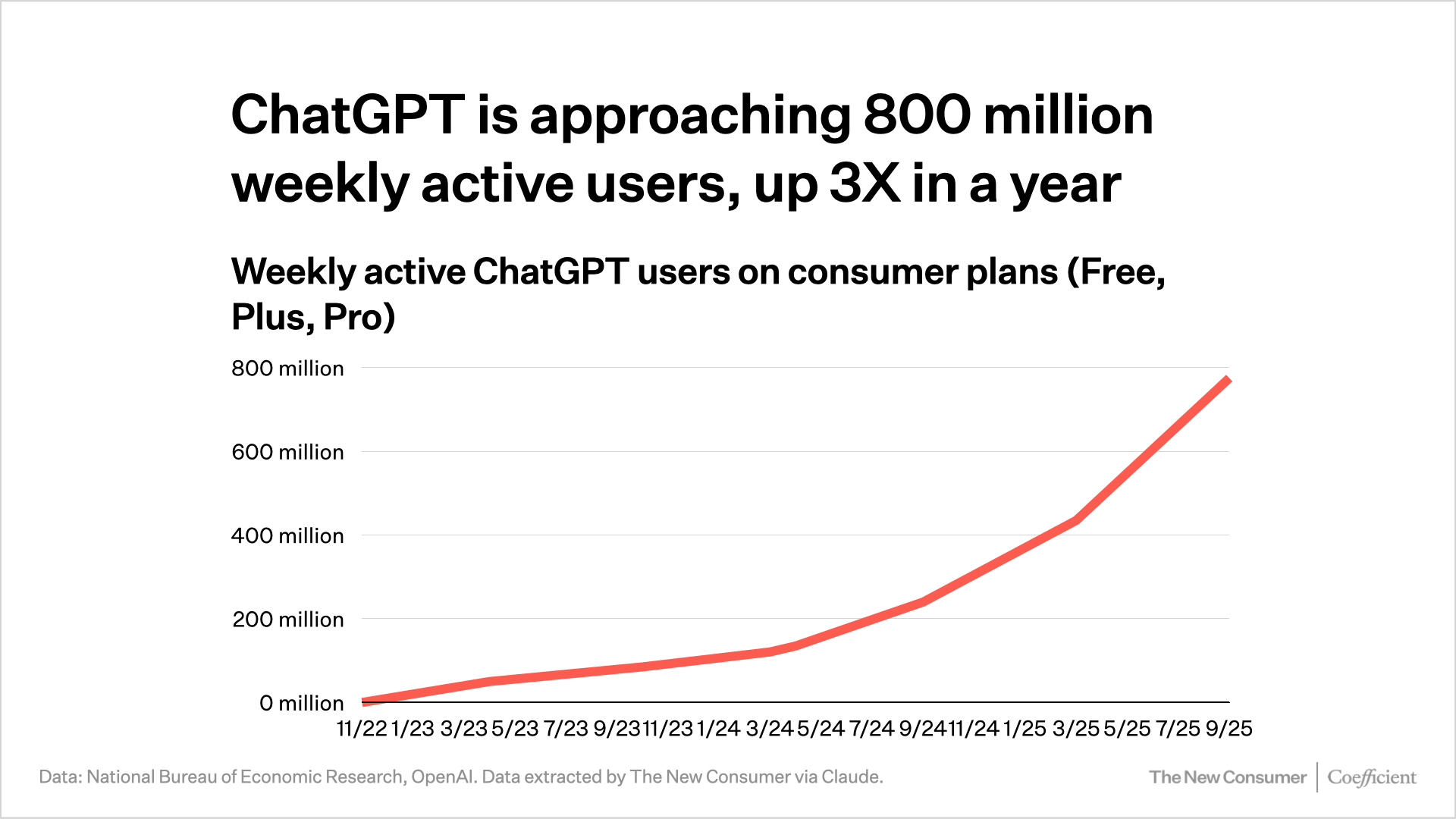
In less than three years since ChatGPT’s launch in November 2022, it has already grown to around 800 million weekly active users globally, and the pace of adoption has accelerated over the past year. This is a spectacular adoption curve, representing around 10% of the global population.
ChatGPT will probably reach 1 billion weekly active users in early 2026, just over three years into its existence. For context, it took Facebook almost a decade to reach that level of popularity, and likely took Instagram eight to nine years.
(Note that these published figures only include users on consumer-grade ChatGPT plans, including Free, Plus, and Pro plans, and exclude users on plans for enterprise teams or education subscriptions. So the total number of active ChatGPT users is probably higher, though not by a giant amount.)
While ChatGPT’s growth and prominence is impressive, it’s still early — and the platform wars are just beginning.
The New Consumer Executive Briefing is exclusive to members — join now to unlock this 2,900-word post and the entire archive. Subscribers should sign in here to continue reading.
Hi, I’m Dan Frommer and this is The New Consumer, a publication about how and why people spend their time and money.
I’m a longtime tech and business journalist, and I’m excited to focus my attention on how technology continues to profoundly change how things are created, experienced, bought, and sold. The New Consumer is supported by your membership — join now to receive my reporting, analysis, and commentary directly in your inbox, via my member-exclusive newsletter. Thanks in advance.